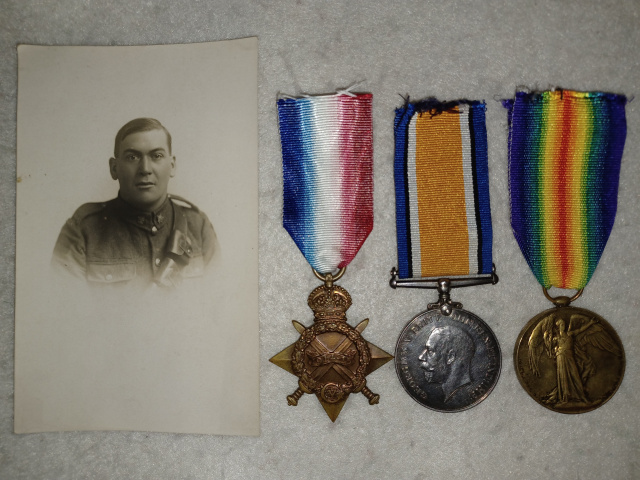
2nd Battalion Casualty Trio with Photo to Bickford, from The Scilly Islands, KIA at Givenchy
A 1914-15 Star, bronze, full size, reverse impressed 22838 PTE N. BICKFORD. 2/CAN:INF. A British War Medal, silver, full size, rim impressed 22838 PTE N. BICKFORD. 2-CAN. INF. Victory Medal, bronze gilt, full size, rim impressed 22838 PTE N. BICKFORD. 2-CAN. INF.Accompanied by a black and white postcard depicting Pte. Bickford, measures 87 mm (w) x 137 mm (l), very minor wear/foxing, Medals near extremely fine condition on Polyester Ribbons.
Private Norman Bickford was born at The Bant, St. Mary's, Isles of Scilly, Cornwall, England, in June 1893 to Mary and William Charles Bickford. He enlisted in Quebec City on September 29, 1914 and sailed on October 3, 1914. Whilst serving with the 2nd Canadian Infantry (Eastern Ontario), he was first reported missing on June 17, 1915, and later confirmed killed in action at Givenchy. He is commemorated on the Vimy Memorial.
At the Battle of Givenchy in June 1915, the 2nd Canadian Infantry Battalion was involved in a costly and intense engagement that formed part of a broader Allied effort to disrupt German defenses along the Western Front. On June 15, 1915, the Canadian 1st Division, including the 2nd Battalion, was ordered to support a British offensive launched by the 7th Division.
The 2nd Battalion advanced under heavy artillery and machine-gun fire. Their objective was to capture enemy trenches near Givenchy-lès-la-Bassée, in northern France. Despite some initial success in reaching parts of the German front line, they faced strong counterattacks and severe resistance. The difficult terrain, lack of adequate artillery support, and poor coordination with British units contributed to the operation’s failure. The fighting resulted in heavy casualties, and the 2nd Battalion, like many Canadian units involved, suffered significant losses for limited territorial gain. The battle highlighted the challenges of trench warfare and foreshadowed the costly learning curve the Canadian Expeditionary Force would endure before achieving greater success in later battles like Vimy Ridge.