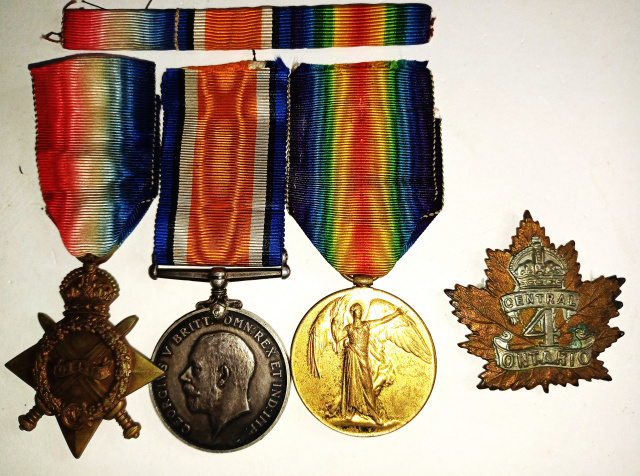
4th Battalion WW1 Casualty Trio to Herbert Harper, who was Killed at Hill 60 with a Cap Badge
A 1914-15 Star, bronze, full size, reverse impressed 11140 PTE H. HARPER. 4/CAN:INF:, original ribbon. British War Medal, silver, full size, rim impressed 11140 PTE. H. HARPER. 4-CAN.INF., original ribbon, dark patina. Victory Medal, bronze gilt, full size, rim impressed 11140 PTE. H. HARPER. 4-CAN.INF., original ribbon. With sew on ribbon bar.
Average GVF Condition.
A 4th(Central Ontario) Battalion Cap Badge, in browning copper with white metal insignia, reverse bears two lugs, marked TIPTAFT BHAM,
measures 43.65 mm (w) x 44.90 mm (h), light verdigris to the copper along the edges, remains very fine.
Herbert Harper was born in Huddersfield, England in 1889. Prior to enlisting in the Great War, he had 18 months experience with the 29th Light Horse Cavalry, and was employed as an electrician. He signed his attestation papers at Valcartier in September of 1914, and sailed to England on October 3.
He served with the 4th Battalion, Canadian Infantry. He was hospitalized in April 1915 for a hernia and later that year, in September for chancroids and phymosis [sic]. Pte Harper was killed in action on May 6, 1916.
The circumstances of casualty record reads “when in Trench 48, at Hill 60, Zillebeke, he was hit in the head by an enemy bullet and instantly killed.”
In early 1916, the 4th Battalion, Canadian Expeditionary Force, part of the 1st Canadian Infantry Brigade, 1st Division, was stationed in the Ypres Salient, holding the front lines around Hill 60 and Sanctuary Wood. This sector, located south of Zillebeke, was one of the most dangerous parts of the front, riddled with enemy mines, heavy shelling, and constant sniper fire. During March and April 1916, the 4th Battalion alternated between front-line and support duties, improving trenches, repairing wire, and conducting night patrols and small-scale raids. The men endured near-daily bombardments and the continual threat of underground explosions from German mining operations beneath Hill 60. Although no major Canadian attack occurred there that spring, the battalion suffered steady casualties from shellfire and raids, and its time in the Hill 60 trenches was marked by exhausting defensive work and harsh conditions typical of the Ypres front before the German assault at nearby Mount Sorrel in June 1916.