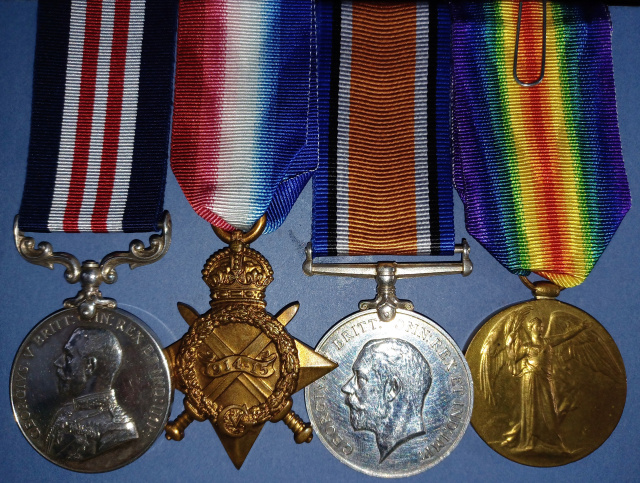
Military Medal, G.V.R. (1719 Sjt. P. J. Rutherford 23/R.Fus.) 1914/15 Star (SPTS-1719 Sjt. P.j. Rutherford. R. Fus.) British War and Victory Medals (GS-1719 WO CL 2 P.J. Rutherford R.Fus.
Extremely fine on new polyester ribbons.
With details here extracted from on-line records :-
Patrick John Rutherford was born in Mooltan, India 22 nd December 1882 a 32 year 210 days old Telegraphist he attested for the 23rd (1 st Sportsman’s) Battalion Royal Fusiliers on 6th May 1915. A giant of a man by First World War standards standing at six feet two and a half inches tall he obtained rapid promotion, appointed Lance Corporal 17th June 1915, promoted Corporal 5th July 1915, appointed Lance Sergeant 5th July 1915, promoted Sergeant 17 th August 1915 and Company Sergeant Major 13th January 1917. Patrick served in France from 11th November 1915, he was wounded in action, published in the War Office Casualty List dated 26th March 1916. Wounded in action a second time 17th February 1917 gun-shot wounds left thigh (from a grenade) during the attack and capture of the Red Line near Ovillers, Somme sector.
The attack went in at 05:45 hours and the objective was captured at a cost of 5 officers killed in action, four wounded and one missing with thirty other ranks killed in action, one hundred and sixty five wounded and thirty two missing. Awarded the Military Medal London Gazette 19th February 1917 page 1754 the date suggests an award for the attack on Munich Trench, Somme sector 14th November 1916. Patrick was evacuated to England and was admitted to King George Hospital London 2 nd March 1917 and was an in-patient there until 26 th June 1917. Posted to Depot Royal Fusiliers 2nd March 1917 and to the 5th Battalion 6th July 1917, he did not return to France and was discharged to Class “Z Army Reserve 12th March 1919. The 1939 Register records he is employed as a Press Telegraphist residing with his wife Ada, son and daughter at Radbourne Road, Solihull, Warwickshire, he died there in 1945 aged 63 years.
4,987 men served on the effective strength of the 23rd Royal Fusiliers after it proceeded overseas to France on 15th November 1915. 3,241 became casualties, of whom 594 died and another 350 were missing.
It was originally recruited at the Hotel Cecil in London by Mrs E. Cunliffe-Owen, with a special War Office dispensation to form a unit from men up to the age of 45, who were then over the formal enlistment age, but who were fit and hard because they were sportsmen. In the first year while the Battalion was training at Hornchurch, it also had a huge turnover of men who received commissions in other units, not counted in the totals above.