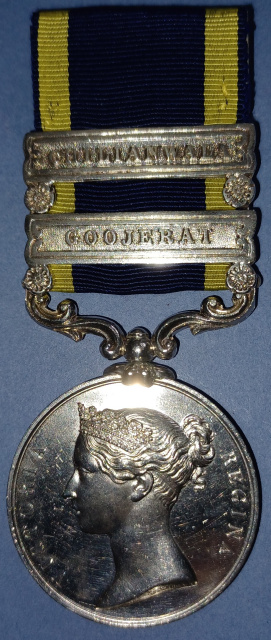
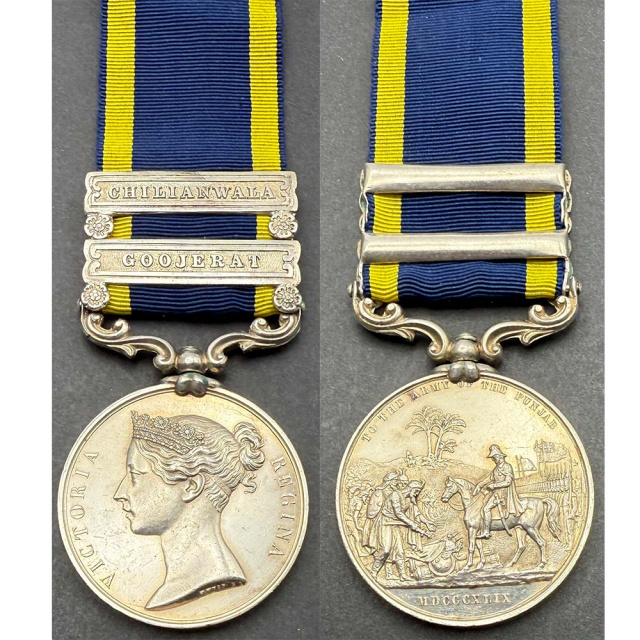
His obituary detailing his service in the Broad Arrow 13th October 1877:
“CAPTAIN MICHAEL WALL, on the Half-pay list of Quartermaster, died recently at his residence in Battersea.
After a long service in the ranks of the 61st Foot, he was promoted from Sergeant Major to an Ensigncy in the 17th Foot, in November 1840, but rejoined the 61st as Quartermaster in February 1841, finally retiring in July 1856.
He served with the regiment in the Punjaub campaign of 1848-49, and was present at the Passage of the Chenab, Battles of Sadoolapore, Chillianwallah and Goojerat, and with the field force in pursuit of the enemy to the Khyber Pass (Medal with two clasps).”
Quartermaster and Captain Michael Wall was born in Wicklow, County Wicklow, Ireland, on the east coast of Ireland just south of Dublin on 29th September 1800.
He first began his Military Career attesting for service as a Private in the 61st (South Gloucestershire) Regiment of Foot on 26th July 1820.
It took under 2 years to first reach Corporal on 25th March 1822.
This was followed by being promoted to Sergeant on 4th March 1824.
He then was promoted to Sergeant Major on 1st September 1837.
Having done 20 years in the regiment he was given the rare honour of a Commission, which was “Without Purchase”, earned on merit instead, when he was appointed as an Ensign in the 17th (Leicester) Regiment of Foot on 6th November 1840.
He would return back to the 61st Foot with whom he had spent all of his career up to his Commission on 16th February 1841, fortunately for him an opening had come up as William Clarke had retired to half pay leaving Michael to fill the vacancy.
Finishing off his career being put on half pay at 10/. a day and the honorary rank of Captain in June 1856, it had been a long 36 years since he had first joined up as a young Private back in 1820.
Not long after he joined up with the Army, he had married Catherine M’Cawley at Dublin on 3rd July 1820.
His two children William Henry was born on 15th August 1831 in Colombo, Ceylon and Frederick Francis on 7th october 1837 in Kandy Ceylon.
His papers recall his battle honours in further detail as:
“Pass of the Chenab and Battle of Sadoolpoor on the 3rd December 1848 under Major General Sir J. Thackwell.
Battle of Chillianwalla on 13th Jan 1849 and Battle of Goojerat, 21 Feb 1849 under General Lord Gough Commander in Chief East Indies
With the Field Force under Major General Sir W.R. Gilbert in the pursuit of the Enemy to the Khyber Pass in March 1849.
Punjaub Campaign of 1848-9.”
During his career he saw the following overseas postings:
West Indies, 13th Jan 1821 – 27th May 1822
Ceylon, 11th November 1828 – 24th October 1839.
East Indies, 1st July 1845 –
He died on 6th May 1877 in Battersea.
On the 30th of June, 1828, the service companies, under the command of Lieutenant-Colonel G. E. P. Barlow, embarked from Gravesend for the island of Ceylon where, they arrived in November, and landed at Colombo.
Lieut.-General Sir Edward Barnes inspected the Sixty-first on their arrival at Ceylon, and inserted the following statement, in his own hand-writing, in the Record Book of the regiment:—
“Having inspected the Sixty-first Regiment, commanded by Lieut.-Colonel Barlow, it affords me much gratification to place upon the Records of the Regiment an expression of my admiration of its appearance and high order,—of the coolness, celerity, and precision, with which it performed the several evolutions, and of its system of interior economy: such a state of things evinces the great ability, assiduity, and perseverance of the commanding officer, and the able support of Major Wolfe and the rest of the officers, and is in the highest degree creditable to the non-commissioned officers and soldiers; and greatly enhances the pleasure which I feel in the renewal of my long acquaintance with the Sixty-first Regiment, and adds very materially and essentially to my satisfaction in having it under my command.
“E. BARNES, Lieut.-General.
“Colombo, December 18, 1828.”
The service companies re-embarked for Colombo in July, and after being inspected by Major-General Sir John Wilson, they marched for Kandy, where they arrived on the 22nd August, 1837.
On the promotion of Colonel Edward Darley to the rank of major-general, on the 28th June, 1838, Major Charles Forbes was advanced to the lieutenant-colonelcy, and the command of the service companies devolved on Major Simmonds.
While on duty at Kandy, the following order was inserted in the Regimental Record Book, by Lieutenant-General Sir John Wilson, K.C.B., in his own hand-writing, viz:—
“Being on the eve of my departure from Ceylon, I feel much pleasure in adding to the honourable testimonies contained in the regimental records, the expression of my approbation of the general good conduct and military discipline manifested by the Sixty-first Regiment, during a period of seven years that it has served under my orders, it having been, during a great part of that time, under the command of the present Major-General Darley.
“It is gratifying to me to be able to state, that at the present half-yearly inspection, after a lapse of so many years, I find the regiment in the same high state of moral and military discipline, in which I had the satisfaction of finding it on my arrival to assume this command, and which had previously called forth the highest eulogiums from my predecessor.
“To have maintained this character during a period of more than ten years’ service in this colony, is a circumstance which cannot but be considered to reflect great credit on the officers, non-commissioned officers, and privates of this distinguished corps, and will, no doubt, meet with a just appreciation in their own country, to the shores of which (as the regiment is about to return home) I earnestly wish them a speedy and prosperous voyage.
“I cannot conclude without requesting the present commanding officer, Major Simmonds, to accept my best acknowledgements for the zeal and attention displayed by him in the command of the Sixty-first Regiment.”
(Signed) “JOHN WILSON, Lieut.-General,
“Commanding the Forces.” Dated “Kandy, 27th December, 1838.”